
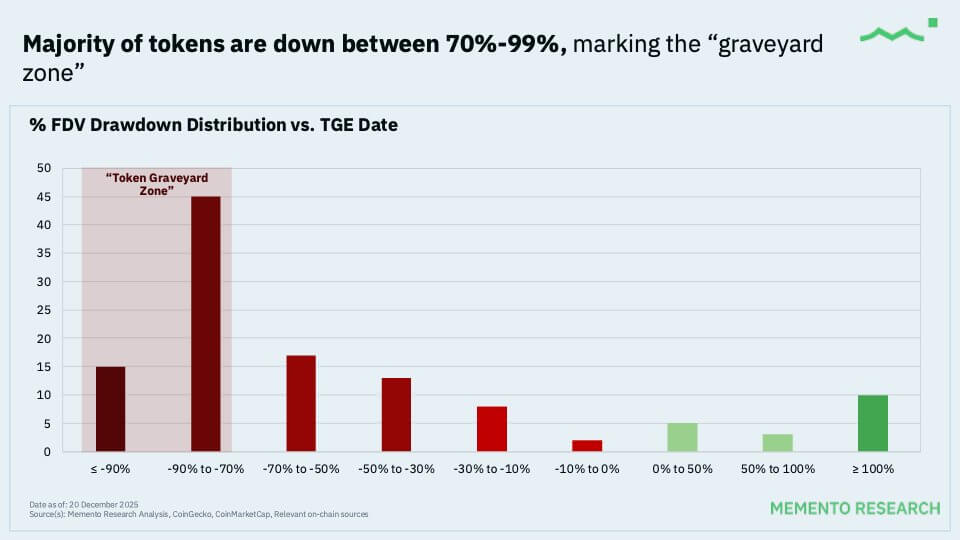
More than 80% of the tokens launched this year are trading underwater, marking a definitive shift in the market’s appetite for venture-backed cryptocurrency projects.
Data from Memento Research showed that it tracked 118 major token generation events in 2025 and found that 100 of them, or 84.7%, are trading below their opening fully diluted valuations. At the same time, the median token in that cohort is down 71% from its launch price.
According to the firm:
“TGE in 2025 often signalled the top for most projects, with price discovery already happening pre-TGE. If you’re buying at launch, you’re basically hunting rare outliers while the median outcome is a ~70% bleed downwards.”
The mechanics of the crash
To understand the severity of the drawdown, it is crucial to distinguish between market capitalization and Fully Diluted Valuation (FDV).
Retail investors typically buy the circulating float, which is usually the 10% to 15% of tokens actually available for trading.
However, the price of that float is increasingly determined by the FDV, which represents the project’s total value once all venture capital and team tokens vest.
Memento’s report showed that the “low float, high FDV” model, where projects launch with a small circulating supply but a massive total valuation, has hit a hard ceiling. It noted:
“The clearest insight was how bigger launches did worse → the hyped, high-FDV token debuts dragged valuations down: 28 launches started ≥$1B FDV: 0% green, median drawdown roughly ~ -81%. [Their] opening valuations are set way too high and above its fair value, resulting in worse long-term performance with larger % drawdowns.”
This meant that high-profile projects with high FDVs like Berachain saw their valuations compress violently after launch.
For context, Berachain, a layer-1 blockchain that commanded significant hype, saw its implied valuation drop from over $4 billion to roughly $300 million.
While these drops represent “paper” losses for locked-up insiders, they translate to real losses for buyers of the liquid token.
Speaking on this situation, Alexander Lin, co-founder of venture firm Reforge, pointed out:
“Marginal buyers [of these tokens] are speculative and treat the market, particularly alts, as a casino. Participants claiming to be fundamentalists with their podcasts and long-form blog posts still prioritize short-termism and are not quality allocators with a long-term strategy.”
The liquidity vacuum
Meanwhile, this token’s underperformance was not solely due to poor tokenomics. It could also be linked to a brutal macro environment that saw the broader crypto market struggle.
According to CryptoSlate’s data, the broader crypto market shed approximately $1.2 trillion in value between mid-October and late November.
During this period, Bitcoin retraced roughly 30% from its $126,000 highs to under $90,000. Still, it remained the primary venue for institutional flows and interest in the crypto market.
This created a tiered liquidity environment. The approval of Spot ETFs in the United States has successfully channeled capital into Bitcoin and Ethereum, but it has arguably cannibalized demand for riskier, long-tail assets.
So, institutional allocators now have a regulated, liquid avenue for crypto exposure that does not require them to diligence new protocols or manage complex custody risks.
Jeff Dorman, Chief Investment Officer at digital asset manager Arca, points to this shift as a primary driver of the TGE failure rate. He noted:
“I don’t know a single liquid fund that has bought a new token on TGE in over two years. That should probably tell you something.”
When liquid hedge funds and family offices abstain from participating in TGEs, the “bid” side of the order book evaporates.
Without institutional support to absorb the initial selling pressure from airdrop recipients and market makers, prices have nowhere to go but down.
So, most crypto TGEs for this year launched into a liquidity vacuum, hoping for a retail frenzy that never materialized.
The ‘predatory’ structure
Nonetheless, the sheer consistency of the losses has reignited a fierce debate over the ethics of the current crypto venture capital model.
Critics argue that the industry has optimized for “extraction” rather than value creation, with insiders incentivized to sell into whatever liquidity exists before the project has established a sustainable revenue model.
Omid Malekan, an adjunct professor at Columbia Business School, suggests that the market is finally punishing this behavior. He said:
“Raising too much money and pre-selling too many tokens destroys value in crypto. Going forward, teams that keep doing this do so knowingly. They care more about extracting a few dollars than achieving success.”
Meanwhile, there were rare crypto projects that bucked the red sea trend, though they often relied on idiosyncratic catalysts.
For context, Aster, a project backed by Binance founder Changpeng Zhao, saw its valuation surge approximately 750% post-launch, growing from a strategic FDV of $675 million to over $5 billion.
Similarly, projects like Humanity and Pieverse maintained their value.
Yet, even among the winners, a pattern emerges: none of the tokens trading above their listing price launched with an FDV of $1 billion or more.
Essentially, the market proved willing to support modest valuations where upside was visible, and it flatly rejected the “unicorn” premiums attached to unproven protocols.
Preparing for 2026
The wreckage of 2025 provides a distinct roadmap for issuers and investors heading into 2026.
The market has signaled that it will no longer accept tokens that serve merely as fundraising mechanisms. The era of the “governance token” that does nothing but vote on forum posts is ending.
Nathaniel Sokoll-Ward, co-founder of RWA platform Manifest Finance, describes the current state of token design as “cargo cult thinking” because these projects mimic the aesthetics of successful networks without the underlying mechanics.
He questioned:
“What problem does the token solve that equity or a traditional cap structure doesn’t? For most projects, the answer is nothing.”
Considering this, the mandate for token issuers is to launch differently next year. The “Price to Reality” ratio must reset; anchoring opening valuations to single-digit multiples of actual annualized fees is the only way to build secondary market support.
Furthermore, projects must “Float like a Business.” The practice of releasing 5% of a token’s supply to simulate scarcity is dead. Issuers need to target initial floats of 15–25% to deepen liquidity and reduce the volatility of early unlocks.
For investors, the shift is behavioral.
Memento Research’s Ash urged investors to treat the TGEs as earnings reports, not lottery tickets. According to him, investors in these projects should map the unlock schedule for the next 30 to 90 days, verify that market-maker terms provide real depth, and track specific catalysts, such as listings and incentives.
Meanwhile, most importantly, he advised investors to be patient, saying:
“I won’t touch most launches until they retrace and let the airdrop fractal play out.”
The post Crypto insiders stopped buying new tokens 2 years ago, creating a liquidity trap that’s crushing retail buyers appeared first on CryptoSlate.